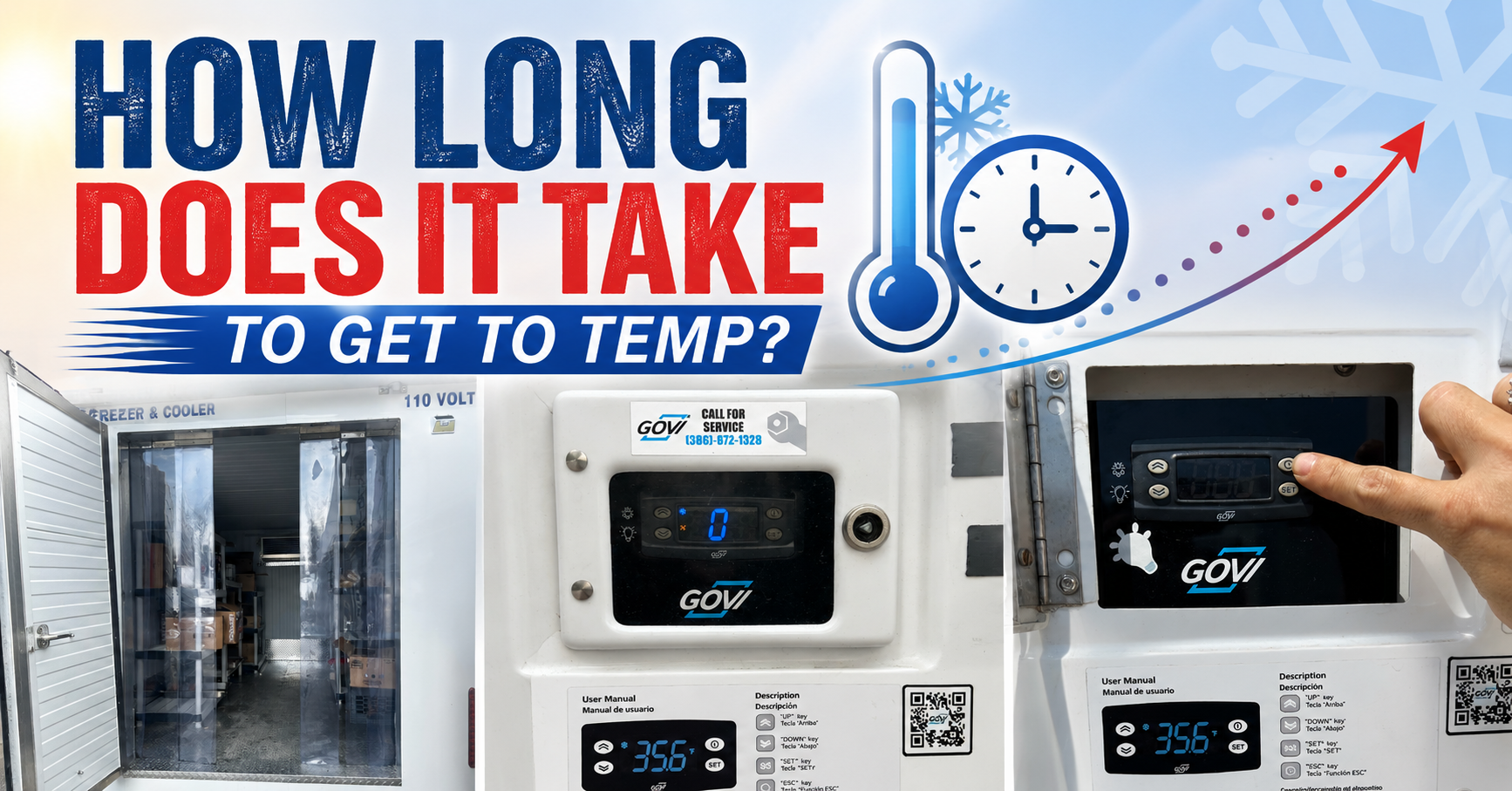
How Long Does It Take a Refrigerated Trailer or Container to Cool Down?
How long does a refrigerated trailer take to cool down? It’s one of the questions we hear most often during summer deliveries — and especially when a customer has called us because a walk-in cooler or freezer has unexpectedly gone down.
In our experience, 110V mobile refrigerated units typically drop about 10°F every 15–20 minutes under normal conditions. An empty trailer starting around 75°F may reach a cooler temperature of 35°F–38°F in approximately one hour, while reaching approximately 0°F for freezer storage typically takes three to four hours.
Actual cool-down time depends on the starting temperature and how the unit is being used (cooler vs. freezer).
This guide explains what affects pull-down time, when to start loading, and what to expect when your temporary cooler or freezer is up and running.
Jump to a Section
- ➤ How Quickly Does a Mobile Refrigerated Trailer Get Cold?
- ➤ Using a Temporary Freezer: How Long Does It Take to Reach 0°F?
- ➤ When Should You Start Loading Product?
- ➤ What Affects Mobile Cold Storage Cooling Time?
- ➤ How We Prepare Units for an Emergency Delivery
- ➤ Do Refrigerated Containers Cool Down at the Same Rate?
- ➤ Temperature Monitoring for Temporary Cooler and Freezer Rentals
- ➤ What If Your Temporary Refrigeration Isn’t Getting Cold Enough?
- ➤ Refrigerated Trailer Cool-Down: The Most Important Things to Remember
How Quickly Does a Mobile Refrigerated Trailer Get Cold?
Starting temperature gives you a useful way to estimate the initial cool-down period. For an empty 110V refrigerated trailer starting around 75°F, a typical pull-down may look like this:
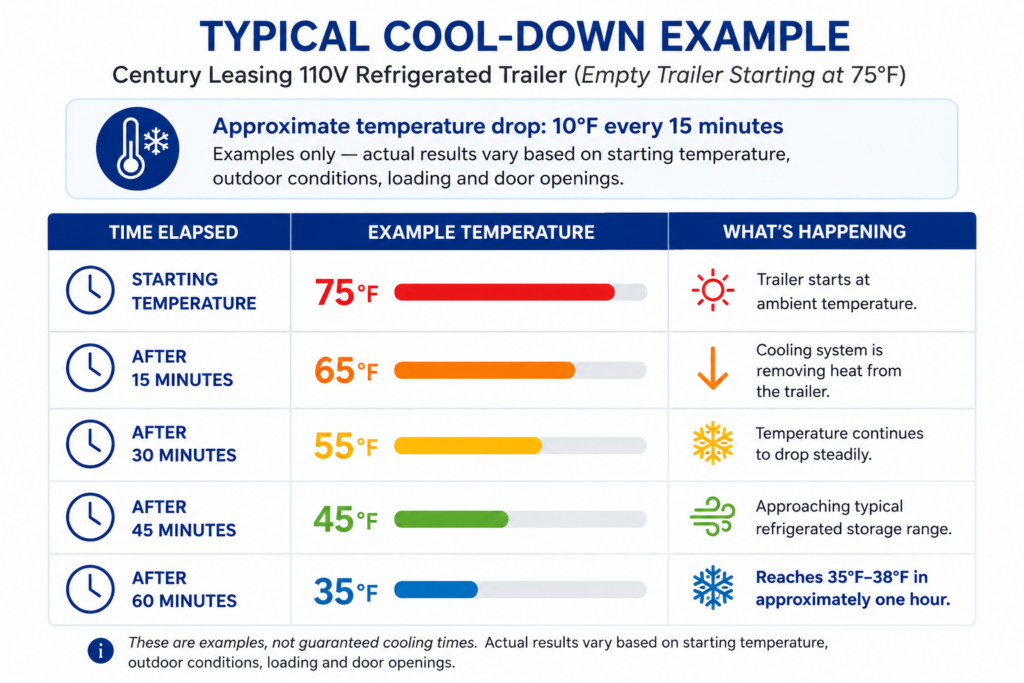
These temperatures are examples, not guaranteed cooling times. Outdoor temperature, door openings, product temperature, and loading conditions can all affect actual pull-down time.
GOVI, the manufacturer of the Arktik refrigeration systems used in many of our 110V units, also advises minimizing prolonged or frequent door openings, particularly in hot and humid conditions.
Simply telling our customers, “it takes about an hour,” doesn’t tell the whole story. A unit starting at 75°F has much less heat to remove than one that has been sitting in 95°F summer weather.
Using a Temporary Freezer: How Long Does It Take to Reach 0°F?
Century Leasing’s 7′ x 12′ and 7′ x 16′ mobile refrigerated trailers operate as a cooler or freezer (0°F–50°F), giving customers two options for temporary storage. The amount of time needed to reach the desired temperature, however, differs between cooler and freezer use.
For freezer use, we generally recommend allowing approximately three to four hours for the unit to pull down to around 0°F. The initial guideline of 10°F every 15–20 minutes shouldn’t be used to calculate the entire trip to freezer temperature because the cooling rate can change as the unit approaches 0°F.
If you know you’ll need freezer storage, tell our team when you reserve the unit. Knowing the target temperature ahead of time helps us plan for the rental and, during an emergency delivery, gives us the opportunity to begin cooling down the unit before it leaves our facility.
When Should You Start Loading Product?
Before you begin loading, let the refrigerated trailer or container reach your desired storage temperature. Adding warmer product while the unit is still pulling down gives the refrigeration system additional heat to remove.
For freezer use, the starting temperature of the product matters even more. A temporary freezer helps maintain products that are already frozen – it will not refreeze partially thawed or melted inventory. Loading a large quantity of partially thawed or warmer product adds significantly more heat for the refrigeration system to remove and can increase the amount of time it takes the unit to recover to the desired freezer temperature.
A few simple loading practices can help the unit maintain temperature:
- Have products organized before opening the doors
- Keep the doors open only as long as necessary during loading
- Leave room around boxes, racks, and pallets for cold air to circulate
- Load products that are already properly refrigerated or frozen
During an emergency, waiting until the trailer reaches its final temperature may not always be practical. If your walk-in cooler or freezer has failed and food is already at risk, call us. We can talk through what you’re storing, the temperatures involved, and how best to use the temporary unit.
What Affects Mobile Cold Storage Cooling Time?
Refrigeration pull-down is affected by more than the number showing on the thermostat. Starting temperature, outdoor conditions, door openings, product load and airflow can all affect how quickly a unit reaches and recovers to its set temperature.
A few things can make a noticeable difference:
- Warm product adds heat. Loading a large quantity of warmer inventory increases the work the refrigeration system needs to do.
- Opening the doors introduces warm air. Repeated trips in and out during pull-down can slow temperature recovery.
- Air needs room to circulate. Packing boxes, racks or pallets too tightly can interfere with the movement of cold air throughout the unit.
- Lower target temperatures take longer. Reaching 35°F for cooler storage is very different from pulling the unit down to approximately 0°F for frozen inventory.
The goal isn’t to leave half the trailer empty. It’s simply to load thoughtfully so cold air has a path to circulate around the products being stored.
How We Prepare Units for an Emergency Delivery
During an emergency rental, we try to give the refrigerated trailer a head start whenever possible.
If a restaurant calls because its walk-in freezer has stopped working or a school suddenly loses refrigeration, there may already be thousands of dollars of food that needs somewhere safe to go.
When circumstances allow, we’ll begin cooling the trailer ahead of time – sometimes even the day before or overnight when we know a freezer temperature will be needed. It doesn’t mean the trailer will necessarily arrive at its final set temperature. It simply means we’ve already started the process before we reach your location to move things along faster.
Once the unit arrives, our team can answer questions about power, placement, temperature settings and loading so you know what to expect instead of standing next to the thermostat wondering if everything is working normally.
Do Refrigerated Containers Cool Down at the Same Rate?
Some of Century Leasing’s refrigerated containers behave similarly to our mobile refrigerated trailers, while others use different refrigeration systems and power configurations.
10′ 110V Refrigerated Containers
Our 10′ refrigerated containers use the same Govi 110V cooling system found on our mobile refrigerated trailers. Their pull-down performance is similar, and they can be used for both cooler and freezer storage.
Ground-level access also makes the 10′ reefer containers useful for customers who need to move carts, racks or inventory in and out without using a trailer ramp.
20′ 110V Refrigerated Containers
Century Leasing also offers a 20′ refrigerated container that operates using 110V power. This configuration has a temperature range of approximately 32°F–50°F, making it a useful option when a customer needs a larger amount of refrigerated storage rather than freezer storage.
Because it operates on 110V power, it can also work at locations where a more complicated electrical setup may not be practical.
20′ Refrigerated Containers with Higher-Voltage Power
Some 20′ refrigerated container configurations can operate using single-phase 220V or three-phase 460V power. These configurations may pull down more quickly than a 110V unit.
Cooling speed, however, is only one part of choosing temporary cold storage. Required temperature, available electrical service, storage capacity, placement and how your team needs to access inventory all matter. Not sure how a refrigerated container compares with a mobile trailer beyond cool-down time? Our complete guide to refrigerated trailers and containers breaks down sizes, temperature ranges, power requirements, and common uses.
Temperature Monitoring for Temporary Cooler and Freezer Rentals
Our team programs the temperature setting for the unit, and most units also have a temperature monitoring system that alerts our team if a unit is running warm.
The programmed setting is retained even if the unit unexpectedly loses power. Once power is restored, the refrigeration system returns to the original programmed temperature setting without the customer having to reset it.
For customers using temporary refrigeration during a walk-in failure, event, renovation, or other busy operation, these features provide an added layer of support after the unit has been delivered and is in use.
What If Your Temporary Refrigeration Isn’t Getting Cold Enough?
First, look at the temperature trend. If the thermostat is steadily dropping, the unit may simply still be pulling down — especially during hot weather or after the doors have been opened for loading.
If the temperature stops dropping or cooling seems unusually slow, check a few basics:
- Are the doors completely closed?
- Has the unit been opened repeatedly?
- Was a large amount of warmer product recently loaded?
- Is there enough room for cold air to circulate?
- Is the unit connected to the proper power source?
- Is the thermostat set to the correct temperature?
Most of our units also have temperature monitoring that alerts our team if a unit is running warm. If something doesn’t look right, call (603) 382-1525 ext. 1 and you’ll reach Mike Jr., who can help troubleshoot.
Refrigerated Trailer Cool-Down: The Most Important Things to Remember
There isn’t one cooling time that applies to every refrigerated trailer, every season or every load. For Century Leasing’s 110V mobile refrigerated units, approximately 10°F every 15–20 minutes is a useful rule of thumb under typical conditions.
An empty unit starting around 75°F may reach 35°F–38°F in approximately one hour. Reaching freezer temperatures around 0°F generally requires three to four hours. Higher starting temperatures, particularly during a New England heat wave, can extend those times.
Most importantly, give the unit time to reach the temperature you need before loading whenever possible, keep doors closed during pull-down, and remember that adding warmer product creates additional refrigeration load.
If you have questions, ask. Temporary refrigeration is something our team works with every day, and sometimes a two-minute conversation about what you’re storing, your available power and when you need to load can make planning the rental much easier.
Need Temporary Refrigeration in New England?
Century Leasing provides mobile refrigerated trailers and refrigerated containers for emergency breakdowns, events, renovations, seasonal overflow, large food deliveries and other temporary cold storage needs throughout New Hampshire, Massachusetts, Maine, Rhode Island, Connecticut, Vermont and parts of New York.
If you’re still determining which type or size of unit you need, our guide to choosing the right mobile cooler covers capacity, placement, power requirements, and other considerations before renting.
Tell us what you’re storing, the temperature you need and when you need the unit. Our team can help you determine the right cold storage option and what to expect before you begin loading.
📞 Call Century Leasing at (603) 382-1525 ext. 1 to speak with our team.